
Building energy codes keep getting stricter, and picking the right insulation material really impacts both safety and long-term costs. Phenolic insulation boards have jumped ahead in popularity because they combine what matters most: real fire safety and strong thermal performance.
With new 2026 data, you can finally see how these boards stack up against older options.
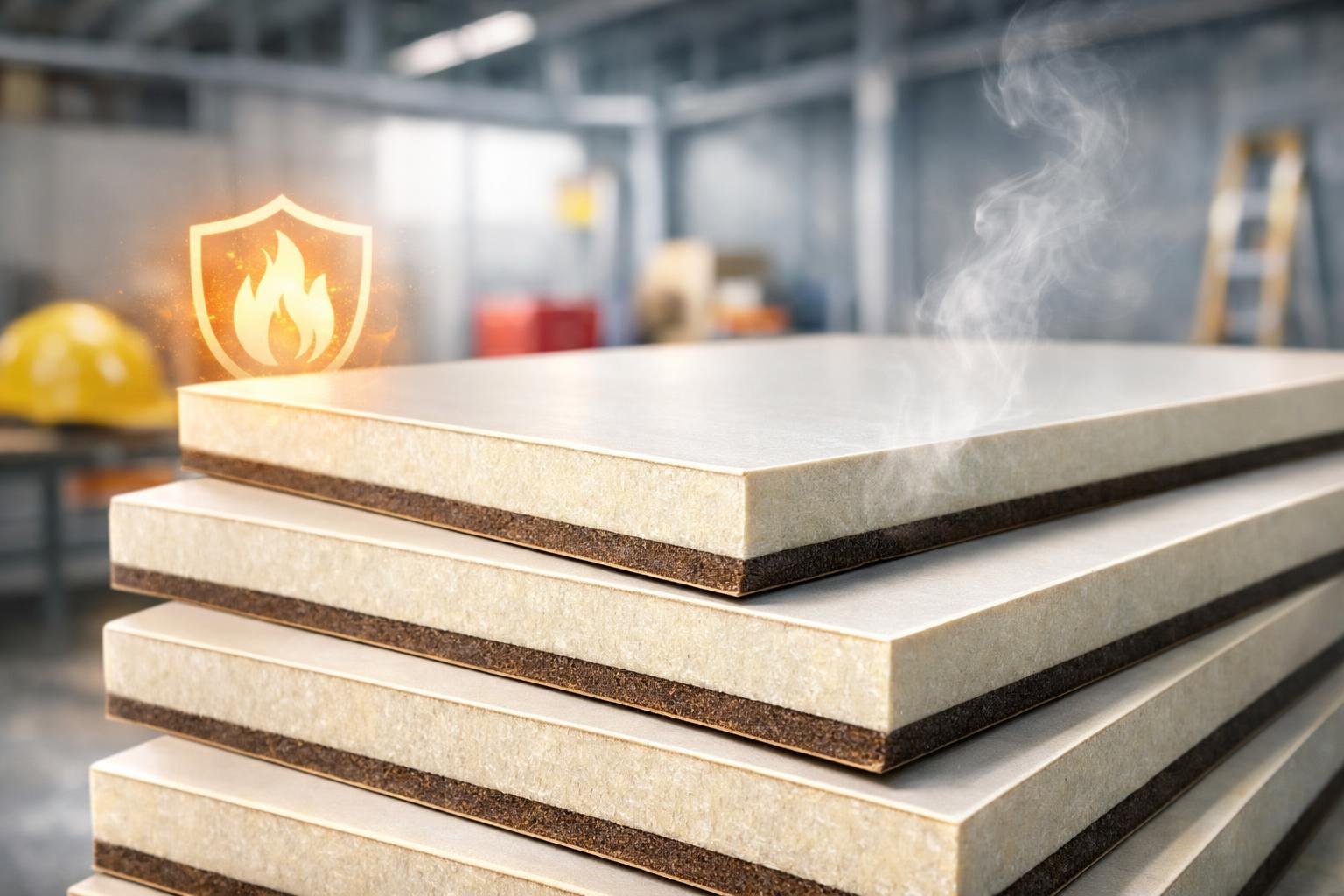
Phenolic insulation boards deliver A-Class fire ratings (BS 476 Class 0 and ASTM E-84 Class A) while maintaining an ultra-low thermal conductivity of 0.02 W/m·K, making them one of the most efficient insulation materials on the market.
The core uses rigid phenolic foam, covered with aluminum foil on both sides. You get built-in fire resistance, moisture protection, and thermal insulation all in one lightweight product.
You’ll find phenolic boards in HVAC systems, wall insulation, and roof insulation. They weigh up to 75% less than traditional duct systems with external insulation, so installation goes faster and labor costs drop.
This material also resists mold and stands up in tough conditions. You get durability that actually lasts.
Key Takeaways
- Phenolic insulation boards meet A-Class fire safety standards and offer thermal conductivity as low as 0.02 W/m·K
- These boards are up to 75% lighter than conventional insulated duct systems, reducing installation costs and time
- The aluminum foil facing provides moisture resistance and prevents mold growth for long-term performance
What Is Phenolic Insulation Board?
Phenolic insulation board is a rigid foam panel made from phenolic resin. Its closed-cell structure brings both thermal efficiency and fire resistance.
The material combines a foam core with protective facings, making a lightweight insulation solution for walls, roofs, and floors.
Material Composition and Manufacturing Process
Phenolic insulation board uses a rigid phenolic foam core laminated between protective facings on both sides. The facings change based on the application, but usually include aluminum foil, glass tissue, or composite materials.
Manufacturers start with phenol-formaldehyde resin synthesis. Most use Resole systems for better crosslink density and fire resistance.
They add a foaming agent to the resin under controlled conditions, which causes the mixture to expand and harden into rigid foam. The foam forms between two flexible tissue-faced layers.
Each phase is tightly engineered so the final product meets performance standards for fire resistance, thermal efficiency, and durability. The facings bond to the foam core as it cures, creating an integrated panel.
Phenolic Resin and Foam Structure
The foam structure has a high closed-cell content with fine, uniform cells. Quality phenolic foam contains at least 90% closed cells, which helps trap gas and keeps the thermal performance steady over time.
These airtight cells trap gas with low thermal conductivity. That’s what makes phenolic foam more efficient than open-cell alternatives.
The cell walls in good foam are intact—no windows or holes for the blowing agent to escape. This closed-cell design also gives water resistance.
Each cell acts as a barrier against moisture, so water absorption usually stays below 2% by volume.
Key Performance Characteristics
Phenolic insulation board offers thermal conductivity between 0.019 and 0.023 W/mK. That’s up to 40% more efficient than traditional materials like fiberglass and polystyrene.
The material handles high temperatures without releasing toxic gases, meeting tough safety standards from groups like the National Fire Protection Association.
The closed-cell structure keeps moisture out. Foil facings add another vapor barrier layer. Compressive strength usually ranges from 100 to 150 kPa at 10% deformation.
Even with their rigid structure, these boards stay lightweight. That makes installation easier but still keeps mechanical stability for most building jobs.
A-Class Fire Resistance: Standards, Ratings, and Test Data
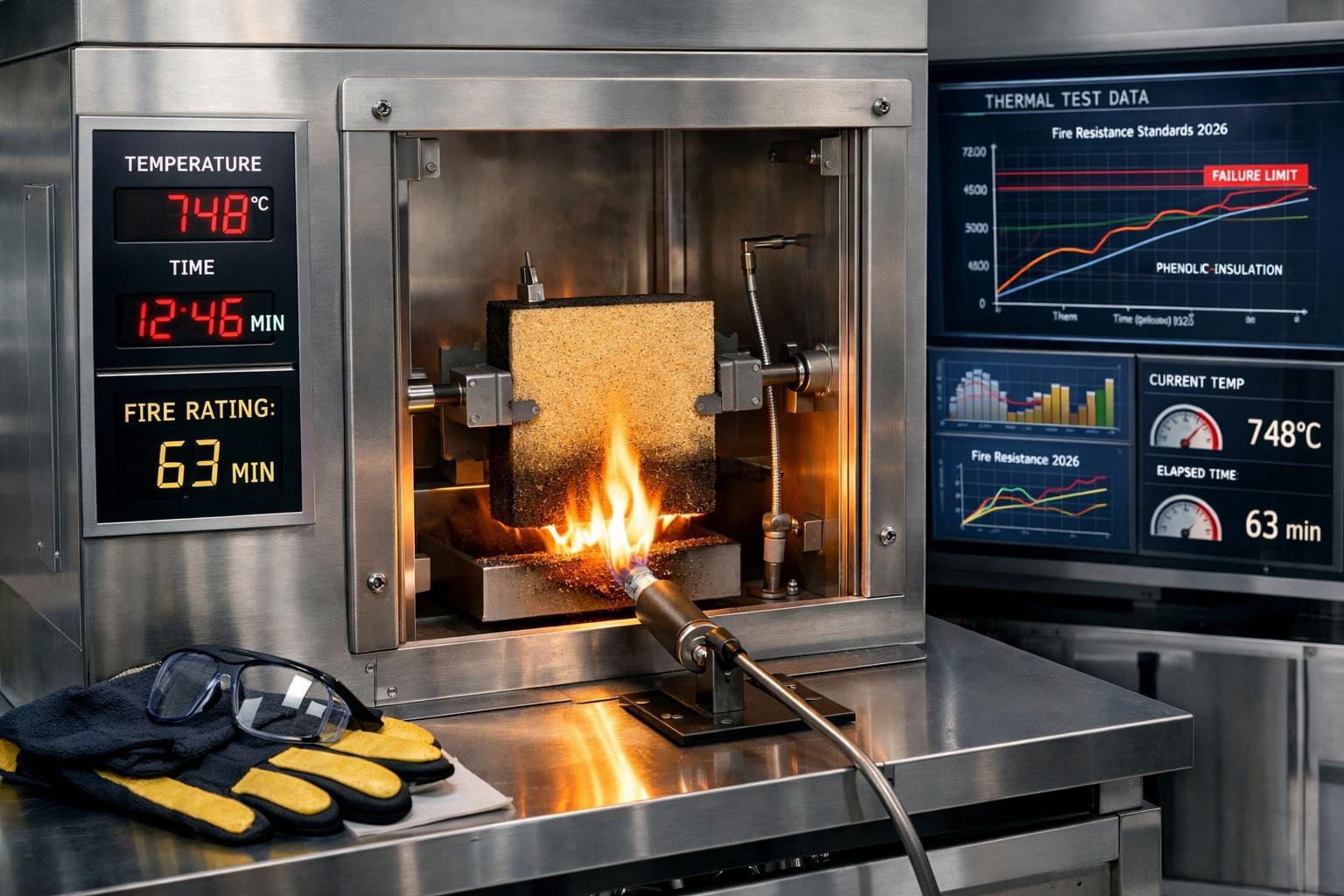
Phenolic insulation board achieves top-tier fire safety through strict testing that measures flame spread, smoke production, and material behavior under extreme heat. These certifications show phenolic’s fire resistance is ahead of alternatives like spray foam, EPS, and fiberglass.
Fire Ratings and International Standards
Phenolic insulation boards usually earn the highest fire ratings under several international standards. In Europe, phenolic foam often gets a B or B-s1,d0 classification under EN 13501-1, which means very limited fire contribution and minimal smoke.
The B1 fire rating under German DIN 4102 backs up phenolic’s low flammability. In the US, phenolic products commonly hit Class A or Class 1 ratings on ASTM E84 tests.
Those labels require strict limits for flame spread and smoke. Fire safety codes differ by region, so it’s worth double-checking which standards your project actually needs.
ASTM E84 and Other Certifications
The ASTM E84 test, or Steiner Tunnel Test, measures two main things for phenolic insulation. Your board needs a Flame Spread Index (FSI) of 0-25 and a Smoke Developed Index (SDI) of 0-450 to get the Class A mark.
During the 10-minute test, a 25-foot sample faces a controlled flame. Labs measure how fast the fire moves and how much smoke builds up. Phenolic foam’s structure and chemistry help limit flame spread.
UL certification gives third-party proof of these results. Always ask for manufacturer data showing FSI and SDI values for the exact product you want. Some phenolic foams hit FSI as low as 5-15, which is well below the Class A threshold.
Flame Spread, Smoke Generation, and Toxicity
Phenolic insulation really limits flame spread because of its thermoset polymer structure. When fire hits, phenolic foam forms a char layer that protects the material underneath and slows burning.
Smoke generation is a big safety factor. Phenolic boards usually produce lower smoke density than polyurethane (PUR) or polyisocyanurate (PIR) foam insulation.
That lower smoke output keeps visibility up during evacuation and reduces breathing hazards. Toxicity tests check what chemicals are in the smoke.
No burning material is totally safe, but phenolic foam makes fewer toxic byproducts than most plastic-based insulation. For spaces where people might be exposed to smoke, it’s smart to review the specific toxicity data.
Comparison With Other Insulation Fire Ratings
Phenolic insulation shows better fire resistance than most common options. Mineral wool insulation is non-combustible and gets similar or even better ratings, while fiberglass insulation usually earns Class A with similar FSI numbers.
Spray foam products are all over the place. Closed-cell spray foam often needs fire-retardant additives to get Class A, and it generally makes more smoke than phenolic.
EPS (expanded polystyrene) and XPS (extruded polystyrene) only reach Class A when treated with flame retardants, but both will melt and drip in a fire.
| Insulation Type | Typical FSI | Typical SDI | Combustion Behavior |
|---|---|---|---|
| Phenolic Foam | 5-20 | 50-300 | Forms protective char |
| Mineral Wool | 0-5 | 0-50 | Non-combustible |
| PIR/PUR Foam | 15-25 | 200-400 | Melts, higher smoke |
| EPS | 20-25 | 300-450 | Melts and drips |
| Spray Foam | 20-25 | 250-450 | Melts, variable smoke |
Your choice between phenolic and other options depends on your project’s fire safety requirements, thermal performance needs, and budget.
Thermal Performance and Energy Efficiency
Phenolic insulation boards deliver superior thermal protection thanks to their closed-cell structure and super low thermal conductivity. These features directly lead to measurable energy savings and make them a top pick for projects that demand high-performance insulation.
Low Thermal Conductivity
Phenolic insulation boards hit thermal conductivity as low as 0.018-0.022 W/mK. That’s quite a bit lower than materials like fiberglass or mineral wool.
The closed-cell structure blocks heat transfer better than open-cell types. Each cell acts as a barrier, trapping air and stopping heat movement.
This low conductivity means you can use thinner boards for the same insulation value. A 50mm phenolic board often matches the performance of 100mm of typical insulation.
The material holds its low thermal conductivity over time. Unlike some foams that degrade, phenolic boards resist moisture and don’t suffer from thermal drift.
Energy Savings in Real-World Applications
Buildings insulated with phenolic boards see big drops in heating and cooling bills. In commercial projects, energy costs often fall by 30-40% compared to standard insulation.
This material helps you hit green building certifications like LEED or BREEAM. Those benchmarks for energy efficiency? Phenolic insulation usually nails them.
In HVAC ductwork, phenolic boards cut down on energy loss. Conditioned air stays at the right temperature from the source all the way to the delivery point.
Cold storage facilities love phenolic for its steady temperature control with less energy. The insulation stops thermal bridging and keeps things stable inside—even when the outside climate gets wild.
Thermal Resistance and R-Value
Phenolic insulation boards deliver R-values between R-7 and R-8 per inch of thickness. That’s about as high as you’ll find for rigid foam insulation.
| Material | R-Value per Inch |
|---|---|
| Phenolic Foam | R-7 to R-8 |
| Polyurethane | R-6 to R-6.5 |
| Expanded Polystyrene | R-3.6 to R-4.2 |
| Fiberglass | R-2.9 to R-3.8 |
Higher R-values mean better thermal resistance. Your building envelope stands up to heat flow in both summer and winter.
The high R-value lets you design more space-efficient buildings. You get top-notch insulation without eating up valuable space.
Performance in High-Performance Buildings
Net-zero energy buildings lean on phenolic insulation to cut thermal losses. Its high R-value helps create the tight thermal envelope these projects demand.
High-rises get a boost from phenolic boards, too. They’re lightweight and efficient, so you reduce structural load without sacrificing energy performance.
Passive house construction benefits from phenolic’s ability to eliminate thermal bridges at tricky junctions. The material fits right in with strict thermal requirements.
Labs and cleanrooms rely on phenolic insulation for precise temperature control. The boards offer the stable conditions sensitive research and operations need.
Moisture Resistance and Durability
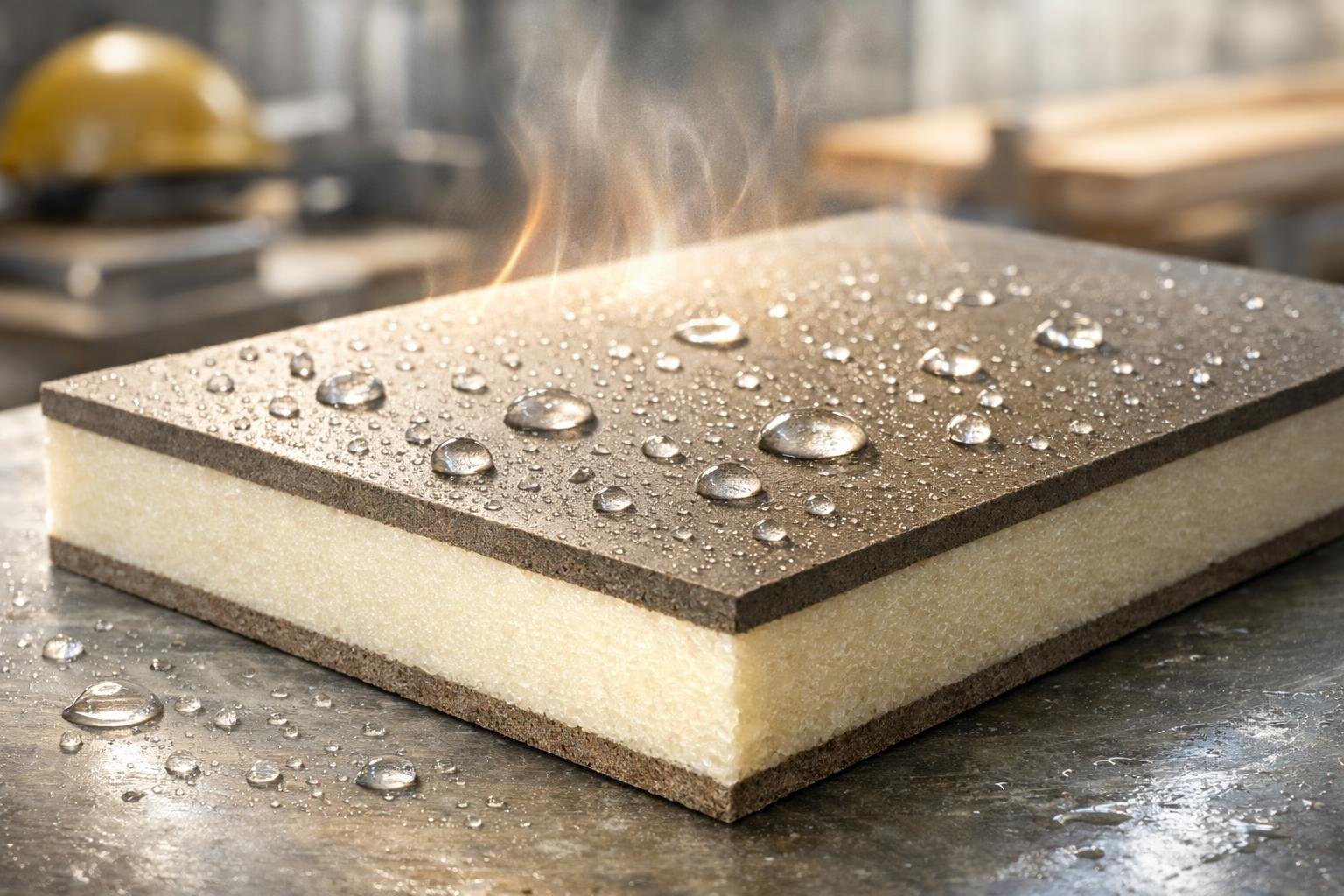
Phenolic insulation board shrugs off water thanks to its closed-cell foam structure. That means it won’t soak up moisture and keeps its thermal performance even when things get wet.
The water resistance also stops mold growth and keeps the board stable for years.
Closed-Cell Structure and Water Absorption
Phenolic foam insulation uses a closed-cell structure, so tiny sealed cells block liquid water from getting inside. Each cell acts as a barrier, keeping moisture out.
Water absorption usually stays under 5% by volume. Even with rain or condensation, the board hangs onto its insulating power.
Since water can’t get in, thermal conductivity doesn’t change much. Other insulation types lose efficiency when wet, but phenolic boards sidestep this issue.
The aluminum foil facing on both sides adds another layer of moisture protection. The foil blocks water vapor from reaching the foam core.
Mold Growth Prevention
Mold needs moisture to survive and spread. Phenolic foam insulation doesn’t absorb or hold onto water, so mold can’t get a foothold.
The closed-cell structure keeps things dry inside, even when it’s humid outside. No trapped moisture means bacteria and fungi don’t have what they need to grow.
This matters for indoor air quality. Moldy insulation can release spores and cause health headaches, but phenolic boards help keep indoor air cleaner.
The material itself doesn’t feed microorganisms. Unlike some organic insulation, phenolic foam doesn’t break down or support mold over time.
Dimension Stability Over Time
Phenolic insulation keeps its size and shape through temperature changes and moisture. The rigid foam doesn’t swell, shrink, or warp in typical building conditions.
This stability comes from the thermoset phenolic resin that forms the foam’s structure. Once it’s cured, the material stays put.
Boards in walls or roofs keep their joints tight for decades. You won’t see gaps opening up as the building gets older.
Temperature swings don’t make it expand or contract much. This stability helps the building envelope hold together in both hot summers and cold winters.
Applications Across Construction and Industry
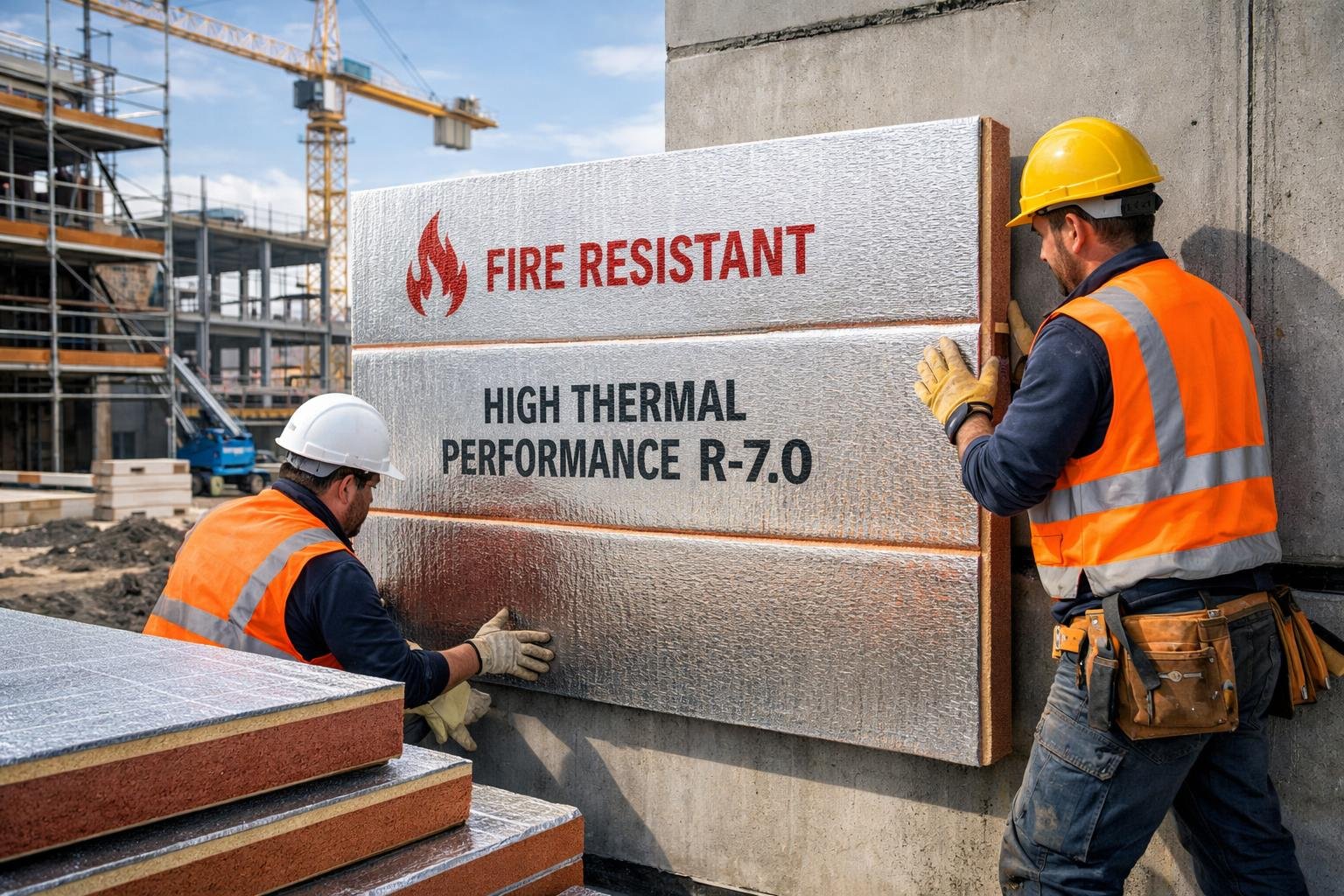
Phenolic insulation boards do a lot—building envelopes, mechanical systems, you name it. With thermal conductivity at 0.02 W/m·K and Class 0/Class A fire ratings, they suit walls, roofs, HVAC systems, and temperature-controlled spaces where energy efficiency and fire safety matter.
External Wall and Facade Insulation
You can use phenolic insulation board on external walls for new builds or retrofits. It gives continuous insulation, cuts thermal bridging, and lowers heating and cooling costs.
The thin profile delivers the same R-value as much thicker materials. That saves space inside and lets you build slimmer walls. The aluminum foil facing acts as a vapor barrier and fends off moisture.
Phenolic boards meet LEED and BREEAM requirements. Their fire resistance makes them a good pick for high-rises and dense urban areas with strict fire codes. You can attach them with fasteners or adhesives, depending on your wall system.
The boards stay stable as temperatures change. They don’t warp or break down during installation, even with typical weather exposure.
Roof and Ceiling Insulation
For roofs, phenolic boards fit both flat and pitched setups. They handle foot traffic during installation and maintenance but keep their insulating properties.
The low water absorption rate (0.25%) keeps roofing assemblies safe from moisture damage. You don’t have to worry if water sneaks into the roof system for a bit. The boards keep their compressive strength (0.25 MPa) under normal roof loads.
You can put phenolic insulation over concrete, metal, or wood decks. They work with single-ply membranes, built-up roofing, and modified bitumen. Their max running temperature of 120°C stands up to summer heat from dark membranes.
The lightweight boards cut down on structural loads. That’s a big deal for older buildings with limited weight capacity.
HVAC and Pre-Insulated Ductwork
Phenolic ductwork combines duct and insulation in one. You make rectangular ducts straight from phenolic foam panels—no need for metal ducts with wrapped insulation.
This method chops installation time by 40-50% compared to old-school systems. Pre-insulated ductwork arrives ready to assemble, so your crew skips the insulation wrapping step.
Duct fabrication uses special cutting tools and jointing compounds for phenolic boards. Corners and fittings keep the system airtight. The aluminum foil inside gives a smooth surface for low friction losses.
Phenolic ductwork is about 75% lighter than insulated metal duct. That means easier handling and less need for heavy structural support. You can move bigger sections with smaller crews.
The system holds its thermal performance without compression or gaps. Air leakage rates stay under 1% if you seal things right.
Cold Storage and Industrial Uses
Cold storage facilities get steady temperatures and moisture resistance from phenolic insulation board. The material stops condensation on cold surfaces and keeps freezers and warehouses stable.
You can use phenolic boards in the walls, ceilings, and floors of walk-in coolers and blast freezers. They handle temps down to -40°C without getting brittle or losing insulation value.
Industrial sites like chemical plants and manufacturing facilities use phenolic for its chemical resistance. The foam stands up to many solvents and cleaners, and it doesn’t support mold or bacteria.
Food processing plants trust phenolic insulation because it meets hygiene standards. The smooth foil surface is easy to clean and doesn’t trap contaminants.
Phenolic Insulation Board vs. Alternative Materials
Phenolic boards post thermal conductivity values of 0.019-0.021 W/m·K, outperforming most other insulation options. Fire resistance and moisture stability also set phenolic foam apart from EPS, PIR, and mineral wool.
Comparison With EPS, XPS, PUR, and PIR
EPS (expanded polystyrene) clocks in at 0.035-0.038 W/m·K for thermal conductivity. You’ll need thicker EPS boards to match phenolic’s performance. XPS (extruded polystyrene) brings better compressive strength—often 200-300 kPa—but its thermal conductivity is still 0.032-0.036 W/m·K.
PIR and PUR boards come close to phenolic, with conductivity from 0.022-0.026 W/m·K. Still, phenolic boards keep lower conductivity longer because their closed-cell structure holds gas better.
Fire performance is where phenolic really shines. Phenolic boards usually hit Class B fire ratings, while EPS and XPS burn more easily. PIR does well with fire, but phenolic often edges it out in tests.
Cost can be a sticking point. Phenolic boards are the priciest rigid foam option. EPS and XPS cost less but need more thickness. PIR lands somewhere in the middle for both price and performance.
Mineral Wool and Fiberglass Alternatives
Mineral wool insulation can reach Class A fire ratings in the right setups. This gives it a real edge where fire safety tops the list.
Its thermal conductivity sits between 0.035-0.040 W/m·K—that’s almost twice as high as phenolic boards. So, you need a lot more mineral wool to match the thermal punch of phenolic.
Fiberglass insulation wins on upfront cost. But you’ll need much thicker layers to hit the same thermal numbers.
Both mineral wool and fiberglass soak up moisture much more than phenolic foam, thanks to phenolic’s closed-cell structure. That makes phenolic a better pick for damp spots.
Compressive strength sometimes tips toward mineral wool, especially in certain floor setups. It handles point loads better than phenolic boards.
Phenolic boards, though, are lighter and easier to move around during install. Their water absorption stays below 2% by volume, so they’re a clear winner in wet places like bathrooms.
Installation, Cost, and Market Trends for 2026
To get the best out of phenolic insulation boards, you need to follow specific installation methods. Market data shows prices have held steady, and demand keeps climbing—energy efficiency rules are really pushing this growth.
If you understand installation best practices, total ownership costs, and supply trends, you’ll make smarter choices about high-performance insulation.
Installation Techniques and Best Practices
Install phenolic foam insulation with mechanical fasteners or the right adhesives made for rigid foam. You can cut these boards with standard tools, but don’t skip the gloves and mask—dust can irritate your skin.
Sealing the joints matters a lot. Tape all seams with foil-faced tape to keep the vapor barrier intact and stop thermal bridging.
For walls, phenolic boards fit between studs or go on as continuous exterior insulation. Either way, keep the details tight.
Key installation considerations:
- Keep boards snug—no gaps, but don’t crush them
- Pick adhesives that play nice with the foam
- Put vapor barriers on the warm side in cold climates
- Leave little expansion gaps for big areas
- Follow the manufacturer’s specs for fastener spacing
The slim profile of phenolic boards makes them easier to carry and install than bulkier traditional insulation. You get the same thermal benefit without the heft.
Lifecycle Costs and Long-Term Value
Phenolic boards cost more at the start than fiberglass or mineral wool. But their low thermal conductivity—about 0.02 W/m·K—means you’ll save on heating and cooling for years.
It’s not just about energy bills, either. Phenolic foam stands up to moisture and keeps its R-value for decades. No settling or sagging like with some other materials.
Fire resistance can also trim your insurance costs, especially in commercial buildings. Plus, since phenolic boards are thinner, you lose less interior space compared to thick insulation.
That space savings can boost your usable floor area, which matters if you’re paying top dollar for square footage.
Global Market Growth and Supply Trends
The phenolic insulation boards market hit USD 1.6 billion in 2025. By 2032, it’s expected to climb to USD 2.8 billion—a 7.3% annual growth rate.
This boom comes from rising demand for energy-efficient buildings, both homes and commercial spaces. Europe leads the way, thanks to strict building energy rules. Buildings there eat up 40% of EU energy use.
Phenolic boards can deliver up to 20% better thermal efficiency than older insulation. That’s a big deal for meeting today’s building codes.
Top companies like Kingspan Insulation, Unilin (Xtratherm), and Asahi Kasei keep investing in new production lines and better products. Supply chains look steady in 2026, but local availability still depends on building activity and local rules.
Frequently Asked Questions
Phenolic insulation boards have to meet fire and thermal standards that shift by region. Getting the most out of them means using the right materials and handling them carefully during install.
What fire classification standards apply to phenolic insulation boards, and what test evidence should be requested?
In North America, phenolic boards get tested under ASTM E84, which checks flame spread and smoke. Ask for Class A fire ratings—that means flame spread indexes of 0-25 and smoke development indexes of 0-450.
Europe uses the EN 13501-1 system. There, phenolic boards usually hit Euroclass B or better, covering fire reaction, flame spread, heat release, and smoke.
When you’re specifying phenolic boards, ask for third-party test reports that show real product performance. Look for recent certifications—within five years is best, since formulas change.
Make sure your specs require documentation on carbonization and char layer formation. Those details show how the board stands up to flames.
How does the thermal conductivity (lambda value) of phenolic insulation compare with PIR, PUR, EPS, and mineral wool in real installations?
Phenolic insulation usually delivers thermal conductivity between 0.018 and 0.023 W/mK in the lab. That’s about as good as it gets for building insulation.
PIR and PUR boards come close at 0.022-0.028 W/mK. EPS lands around 0.030-0.038 W/mK, and mineral wool sits at 0.034-0.044 W/mK.
Real-world installs can shift those numbers. Things like moisture, air gaps, and thermal bridging from fasteners usually lower actual performance compared to the lab.
Phenolic boards tend to hold their performance better when temps swing up and down. Their closed-cell structure keeps out moisture that can wreck other foams.
You can save 30-40% on space compared to mineral wool for the same R-value. That’s huge in retrofits where wall depth is tight.
What thickness of phenolic board is typically required to meet current U-value targets for walls, roofs, and floors?
For walls aiming at U-values of 0.20 W/m²K, you’ll need about 90-100mm of phenolic insulation. That’s with continuous insulation and minimal thermal bridging.
Roofs targeting 0.15 W/m²K usually need 120-140mm. For floors over unheated spaces at 0.18 W/m²K, go with 100-110mm boards.
If your insulation isn’t continuous or you have a lot of metal framing, you’ll need more thickness to make up for thermal bridges. Use area-weighted calculations for real accuracy.
Colder climates with stricter codes might push you to U-values below 0.15 W/m²K, which means thicker boards. Manufacturers give lambda values at 10°C for spec purposes, so use those in your modeling software to get the right thickness for your project.
How do moisture exposure and water absorption affect the long-term thermal performance and dimensional stability of phenolic insulation?
Phenolic boards take in less than 5% water by volume during long-term immersion tests. Their closed-cell structure gives them better moisture resistance than most foams.
Water in the board will lower thermal performance by replacing air with liquid, which carries heat more easily. Even a bit of moisture can drop R-value by 10-15%.
Always include vapor control layers and drainage planes in your install. Phenolic boards aren’t meant to be your only water barrier, even with their low absorption.
The boards stay dimensionally stable under normal moisture—expansion or contraction stays under 2% in standard conditions.
Freeze-thaw cycles don’t usually cause problems above grade. The material keeps its structure and doesn’t delaminate as long as you keep it away from constant water.
Don’t use phenolic boards in always-wet spots like below-grade exterior foundation walls. In those cases, drainage board systems or other insulation types work better.
Which adhesives, facings, and fixing methods are compatible with phenolic boards in common building assemblies?
Polyurethane-based adhesives stick phenolic boards well to concrete, masonry, or existing walls. Apply in ribbons or dots covering about a quarter of the board area.
Mechanical fasteners should be designed to avoid thermal bridging and prevent board damage. Use plastic cap fasteners with wide heads to spread the load and not crush the foam.
Aluminum foil facings laminated to phenolic boards help with vapor control and add some reflective thermal benefit. Factory-applied facings tend to work better than field-applied membranes.
Your fastening pattern depends on wind loads, building height, and board thickness. Usually, 4-6 fasteners per 4×8 board does the trick, with extras around edges and openings.
Cementitious adhesives work indoors where boards attach to drywall or plaster. Don’t use solvent-based adhesives—they can break down the foam.
Seal board joints with compatible tape systems. Acrylic or butyl-based tapes made for foil-faced products keep your air and vapor barriers tight at the seams.
What handling, cutting, and on-site safety practices are recommended to control dust, protect edges, and maintain board performance?
Use fine-toothed saws or hot knives to cut phenolic boards. This helps keep dust down and gives you cleaner edges.
If you need straight cuts, circular saws with carbide blades do a solid job. For thinner boards, a utility knife usually works just fine.
Cutting these boards creates dust that can really irritate your eyes and lungs. So, when you’re making a bunch of cuts indoors, grab some safety glasses and a dust mask—trust me, you’ll thank yourself later.
Lay boards flat on a level surface, away from direct sunlight and rain. Don’t stack them higher than 1.5 meters, or you risk crushing the edges on the bottom boards.
Pick boards up by the edges instead of the faces to avoid scratching or denting them. The aluminum foil facings? They’re surprisingly easy to tear if they snag on anything sharp or rough.
Make sure your crew seals any exposed foam edges if they’ll stay visible in the final build. Use tape or mastic that’s compatible with the board to keep moisture out.
Cold weather—anything below 5°C—makes these boards a lot more brittle. If it’s chilly, you’ll have to handle and install them with extra caution to avoid cracks.
Post time: 4 月-03-2026